
Palo santo has been used for centuries as a natural tool for clearing energy, much like sage or incense. Its sweet, woody scent is often burned to clear stagnant energy from a space, invite in something more positive, or simply mark a moment of intention. Knowing how to use palo santo properly makes a real difference, from choosing the right form to lighting it correctly and keeping it burning once lit. This guide walks through the full process, covering cleansing and protection rituals, a simple prayer to try, and how palo santo pairs with sage, crystals, and other tools. You’ll also find safety tips, how to spot genuine wood, and how to source it sustainably.
Let’s get into exactly how to use it, step by step.
What Is Palo Santo?
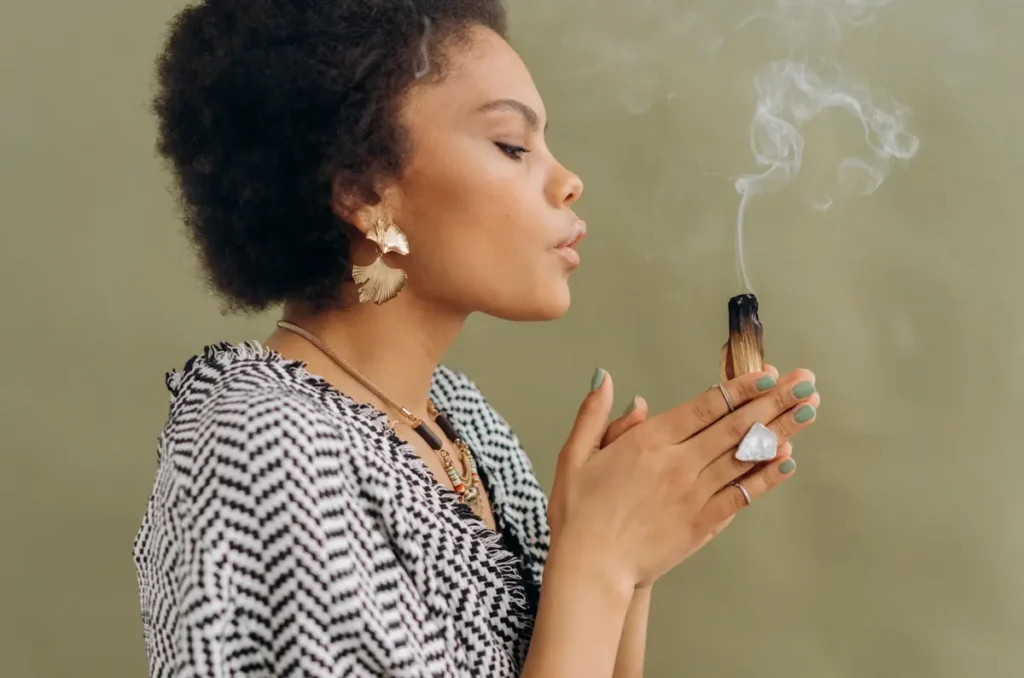
Palo santo is a fragrant wood traditionally used across South America for spiritual cleansing and energy clearing. The name translates to holy wood, reflecting its long-standing use in indigenous ceremonies and healing practices across Peru, Ecuador, and other parts of the continent. The wood comes from a tree native to dry tropical forests, closely related to frankincense and myrrh. It naturally produces a fragrant resin, released as a sweet, woody scent when burned, often described as a blend of pine, citrus, and mint.
Unlike wood that’s cut down while still living, genuine palo santo is only harvested once a tree has fallen naturally and rested on the forest floor for several years. This resting period is particularly critical, as it allows the wood’s aromatic oils to fully develop. Nonetheless, palo santo has been used for centuries on altar, in healing rituals and has been passed down through generations as a tool for clearing negative energy and inviting in calm.
Types of Palo Santo: Sticks, Wood Chips and Oil
Palo santo comes in a few different forms, though sticks remain the most traditional and widely used.
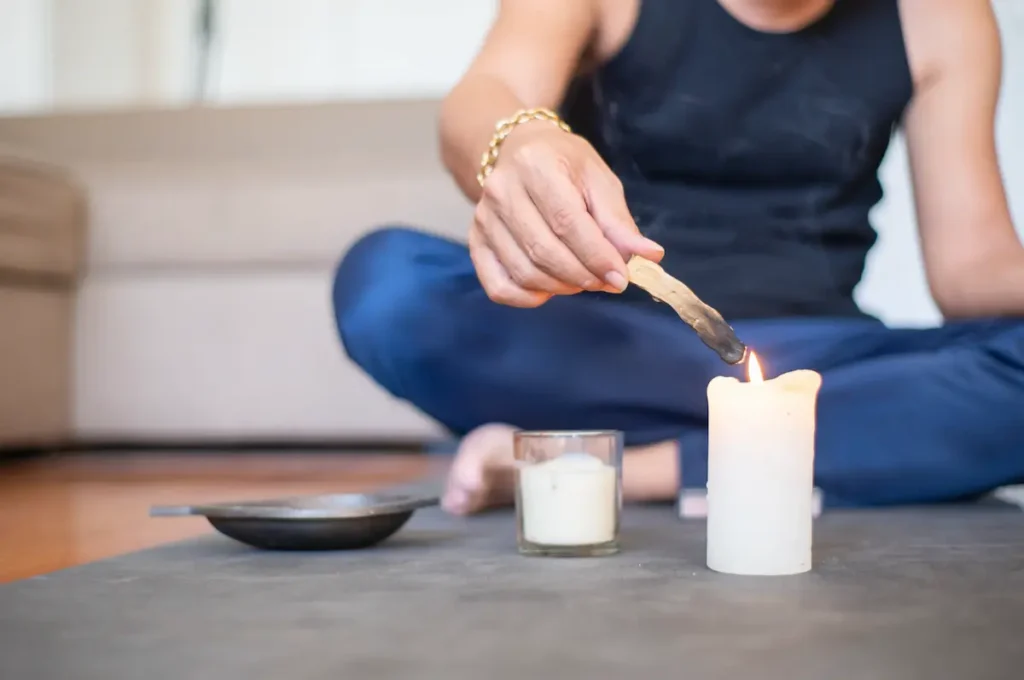
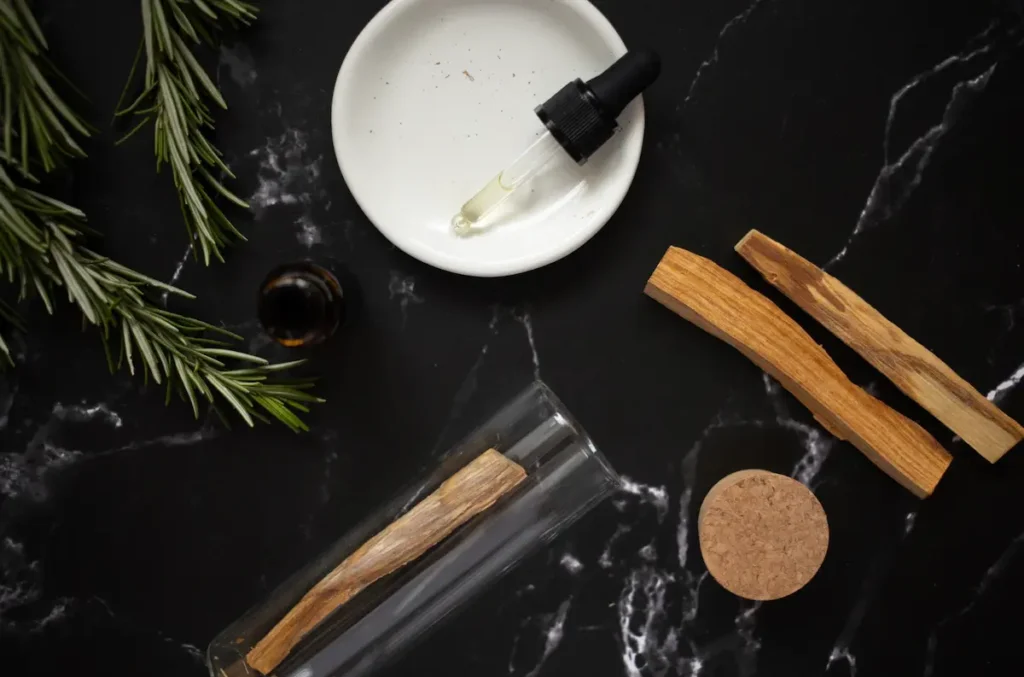
Sticks are the classic form, small, cut pieces of the wood itself, burned directly as covered throughout this guide. Wood chips or powder offer a similar experience but are typically burned over charcoal rather than lit directly. They are useful for those who want a longer, steadier release of scent rather than short bursts. Moreover, palo santo oil, extracted from the same wood, is used differently altogether. It is typically dded to a diffuser, applied to pulse points, or used in an aroma pendant, offering the scent without any smoke or flame at all.
For most rituals involving cleansing or intention-setting, sticks remain the go-to choice. Oil is worth considering if you’re sensitive to smoke, or simply want the scent without an open flame. As such, the rest of this guide is written with them in mind.
How to Burn Palo Santo Sticks: Step-by-Step
Learning how to use palo santo starts with the burning process itself, which is simple once you know the steps.
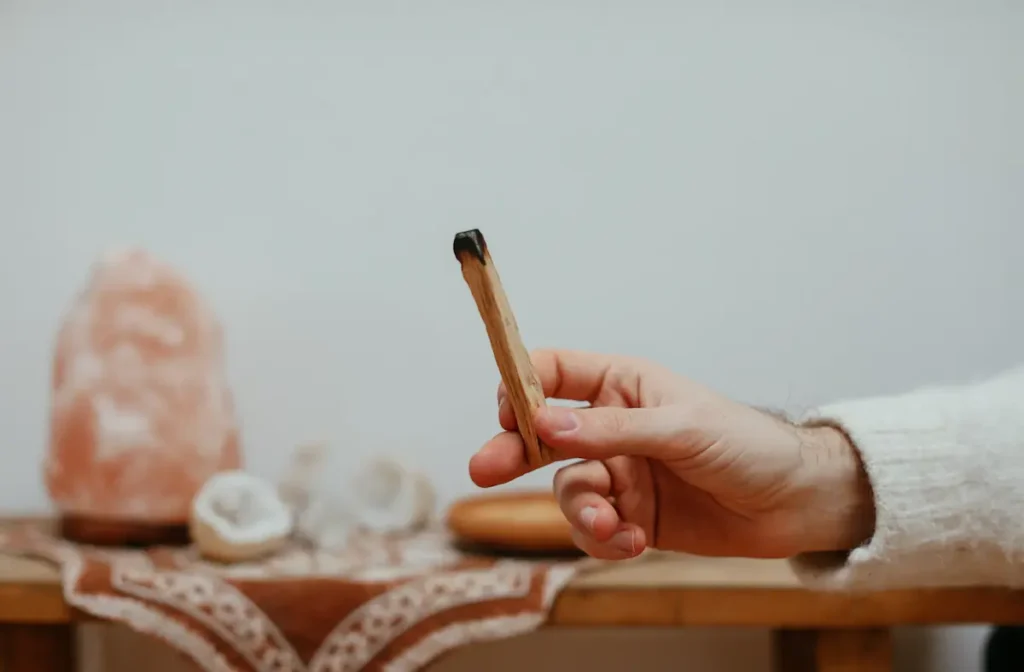
- Hold the stick at an angle. Tilt it roughly 45 degrees, rather than holding it straight up or down, to help it catch evenly.
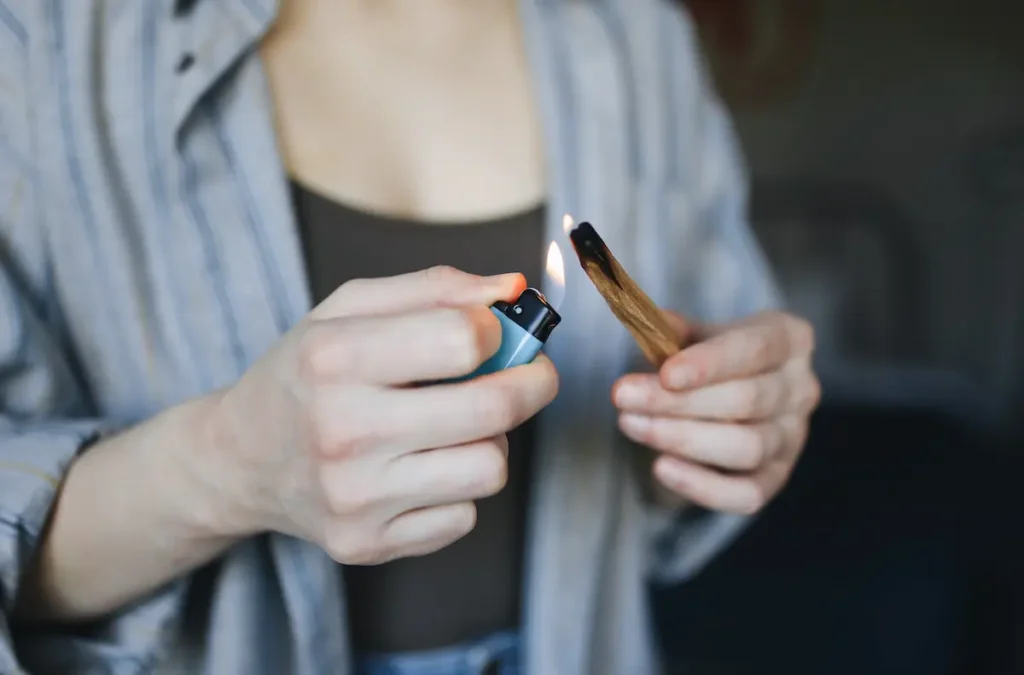
- Light the tip with a flame. Use a lighter or match, and let the flame catch for about 20 to 30 seconds.
- Let it burn briefly. Allow the flame to burn for a further 30 seconds to a minute. This gives the wood enough time to properly ignite before being extinguished.
- Blow out the flame gently. Once the tip is glowing, blow it out the same way you would a candle. The wood should continue to smoke on its own from this point.
- Guide the smoke where you want it. Move the stick slowly around your space, or your body, allowing the smoke to reach each area with intention.
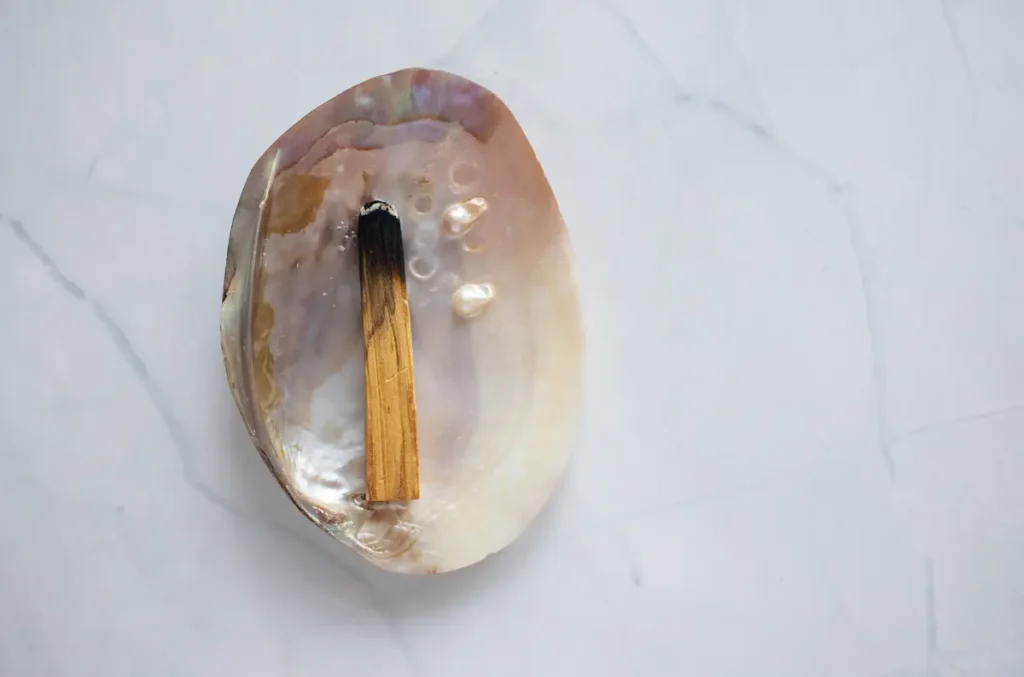
- Rest it in a fireproof dish. Place the stick down between uses to let it continue smoking safely. Ideally, this would be in an abalone shell, ceramic dish, or heatproof tray.
If the smoke stops on its own before you’re finished, that’s normal. Simply relight the tip the same way and continue.
A few tips to get the best burn:
- Use a candle rather than a lighter, if you can. A steady candle flame tends to light the wood more evenly than the quick, direct flame of a lighter. This gives a slightly better burn from the start.
- Expect 20 to 30 uses per stick. Palo santo isn’t meant to burn through in one sitting. A single stick, relit each time you use it, typically lasts through 20 to 30 sessions before it’s fully spent.
How to Keep Palo Santo Burning (Without It Going Out)
One of the most common frustrations when learning how to use palo santo is keeping it lit. This is most commonly due to the wood tending to go out on its own far more easily than sage or incense.
If your stick keeps going out, it usually comes down to one of two causes.
The wood itself may be the issue. Genuine, well-aged palo santo holds a smoulder far better than wood that hasn’t rested long enough, or that’s been cut from a still-living tree. If your stick struggles to stay lit no matter what you try, this is often the underlying cause, rather than anything you’re doing wrong.
Or it may come down to technique. Holding the stick upright, rather than at an angle, or not letting the flame catch for long enough before blowing it out, can both lead to a weaker burn. Angle matters more than most people expect. Holding the stick at roughly 45 degrees allows oxygen to reach the smouldering tip more easily, helping it burn for longer between relights.
Either way, relighting is a normal part of the process, not a sign of failure. Unlike incense, which burns continuously from one end to the other, palo santo is designed to smoke in shorter bursts. Most people relight their stick two or three times throughout a single session.
How to Use Palo Santo for Cleansing Your Space
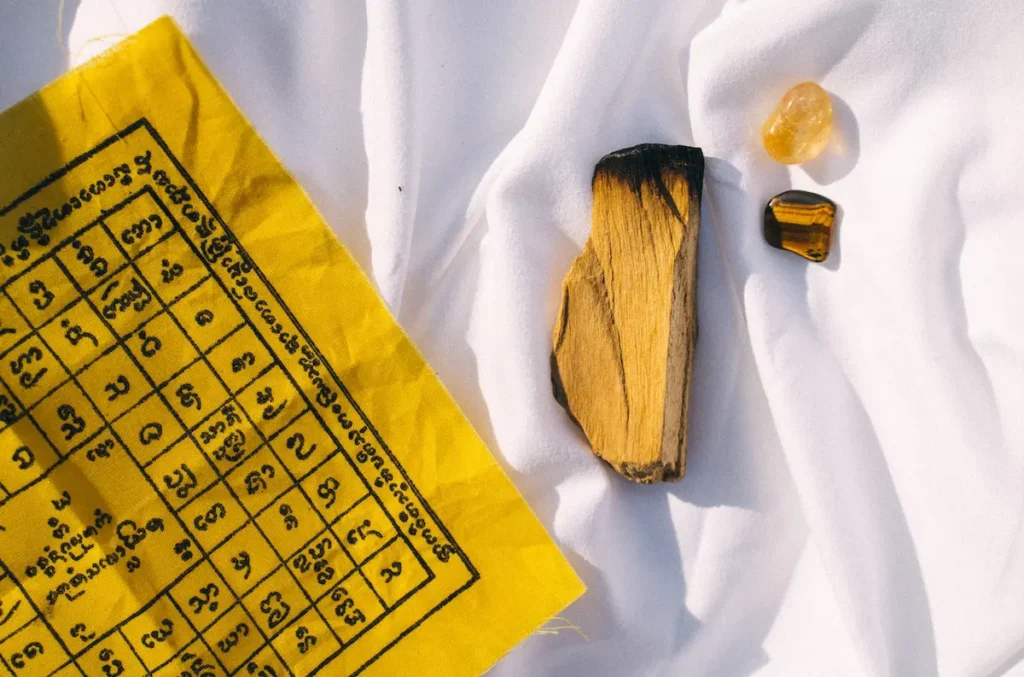
Cleansing is one of the most common reasons people learn how to use palo santo in the first place. As such, the process itself is simple once the stick is lit and smoking.
Start by setting a clear intention before you begin. This doesn’t need to be elaborate, even a simple thought, such as clearing stress or stagnant energy from the room, is enough to guide the practice. Once your stick is smoking, move slowly through the space. Pay particular attention to corners, doorways, and any areas that feel heavier or more stagnant than the rest of the room.
Many people work in a specific order. They often start at the entrance of a room and move clockwise around its perimeter, though there’s no strict rule here. What matters more is moving with intention, rather than rushing through the space. Open a window or door as you go, ideally one that leads outside. This is so that the smoke, and the energy it’s carrying, has somewhere to exit rather than simply settling elsewhere in the home.
Finally, finish by returning to where you started. Set the stick down in its fireproof dish and allow the space to settle for a few minutes before continuing with whatever comes next.
How to Use Palo Santo for Protection and Intention-Setting
Beyond general cleansing, many people specifically use palo santo for protection or to set a clear intention. These are two related, but still slightly different, practices.
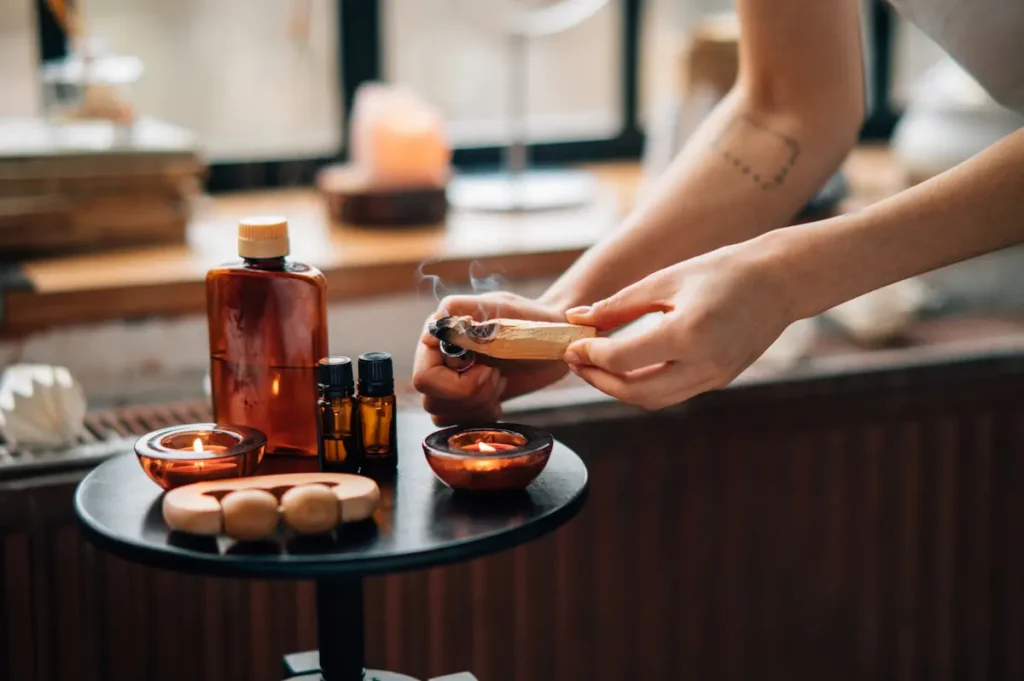
For protection, the focus shifts from clearing a space to sealing it. After cleansing as usual, some people further move the smoking stick around the perimeter of a room. Sometimes they also trace a rough outline around themselves, while holding a specific intention of safety or boundary-setting in mind. This is often done before sleep, before an important event, or during periods that feel especially draining or uncertain.
Intention-setting works a little differently. Rather than clearing something unwanted, the focus is on inviting something specific in. This can include clarity before a decision, calm before a difficult conversation, or focus before beginning a new project. With that in mind, many people hold their intention silently while the stick burns. This allows the scent and the moment of stillness to anchor that thought, rather than treating the smoke itself as doing the work.
Ultimately, both practices tend to work best when kept simple. A clear, specific intention, held for even a minute or two, is generally considered more effective than a vague or rushed one. Some also use this moment before deeper spiritual work, such as meditation or exploring their own energetic origins.

Which Starseed Are You?✨
Your birthmark may be one clue, but it’s rarely the whole picture. Take the free Starseed Personality Quiz for 12 insightful questions that reveal your natural traits and dominant lineage in just a few minutes.
A Simple Palo Santo Cleansing Prayer to Use
A prayer isn’t required, but some find it helps anchor their intention while the wood burns. There’s no single correct version, this is simply one example to adapt or use as a starting point.
I release what no longer serves this space. I welcome in peace, clarity, and calm. May this smoke carry away what is heavy, and leave behind only what is good.
Feel free to adjust the wording to suit your own intention, or skip it entirely and hold the same thought silently instead. The words matter far less than the sincerity behind them.
For those drawn to this kind of intentional practice, our guide to signs you are a starseed explores a deeper layer of self-reflection.
Combining Palo Santo with Other Cleansing Tools
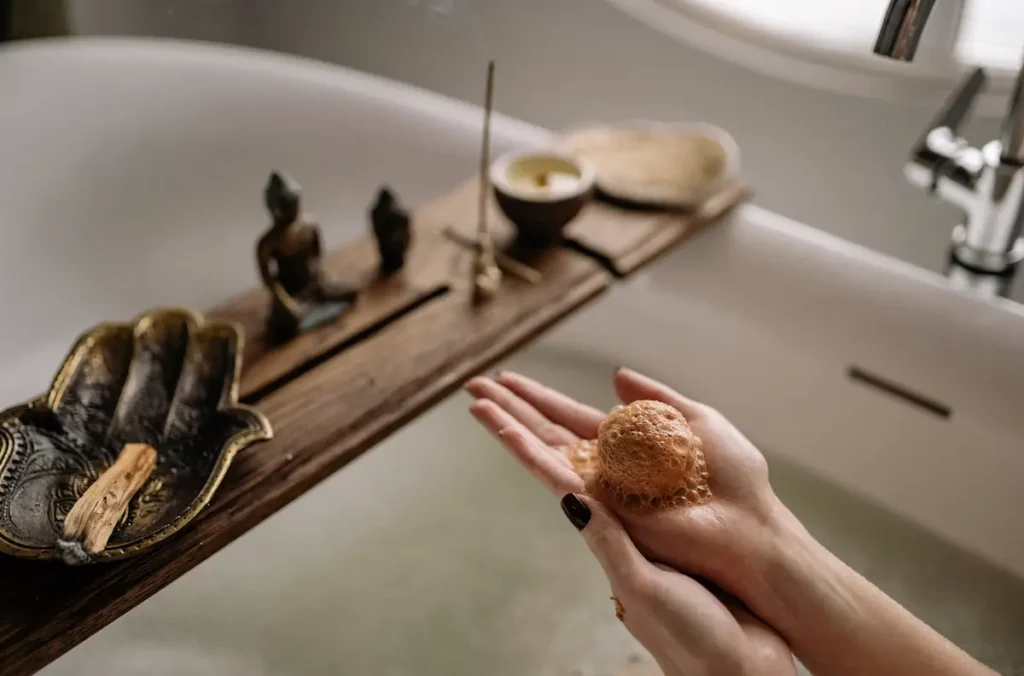
Although Palo Santo can be used alone, it can also be used in combination with other cleansing modalities. As such, many people use multiple cleansing tools, either in the same session or as part of a wider spiritual practice. For a fuller look at tools like these, see our guide to 25 spiritual tools for awakening.
Using Palo Santo and Sage Together
Although palo santo and sage are often used for the same energy-clearing purpose, they are not interchangeable. Sage, particularly white sage, has a stronger, more pungent smoke. It is traditionally used to remove negative energy specifically. Palo santo, on the other hand, carries a softer, sweeter scent. It is more closely associated with inviting in positive energy once a space has already been cleared. The wood itself also burns differently to a bundled herb. Where sage tends to smoulder steadily until it’s extinguished, palo santo is usually burned in short bursts. It is lit briefly, then left to smoke on its own once the flame is blown out.
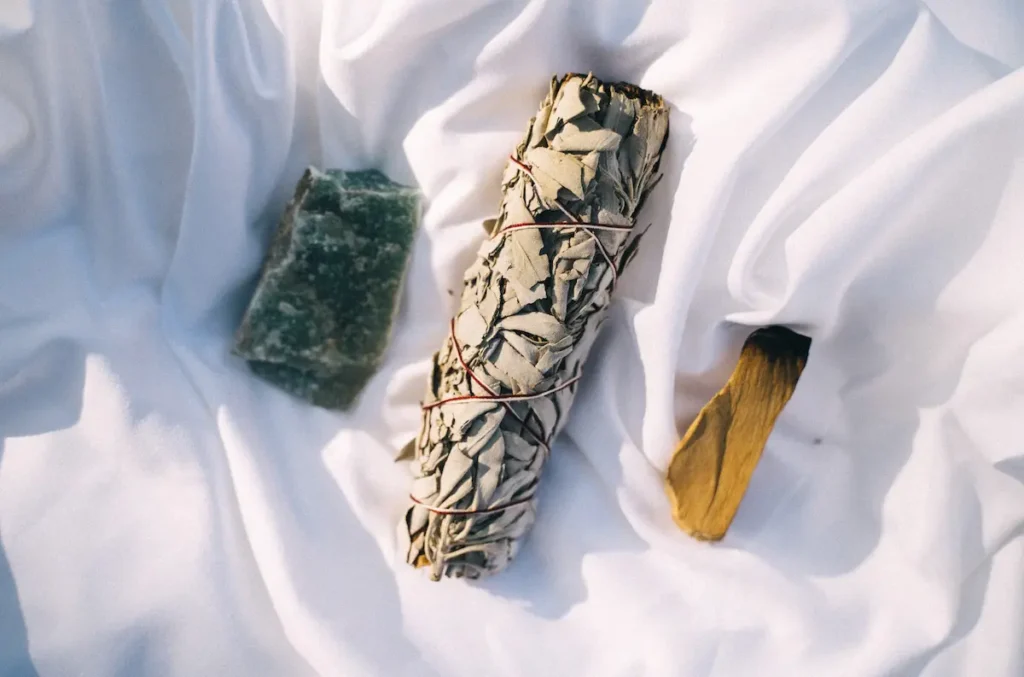
Because of this difference, many people use the two together rather than choosing one over the other. The most typical approach is sequential. Sage comes first, to clear out heavy or stagnant energy, followed by palo santo, to invite in something more positive once the space feels clear. Nonetheless, there is no strict rule on timing between the two. Some people cleanse with sage, then immediately follow with palo santo in the same session, while others prefer to leave a few minutes, or burn them on separate days entirely, depending on how the space feels. If you’re new to combining them, starting with a shorter sage cleanse followed by a brief palo santo session. This is a simple way to get a feel for how the two work together.
Palo Santo and Crystals
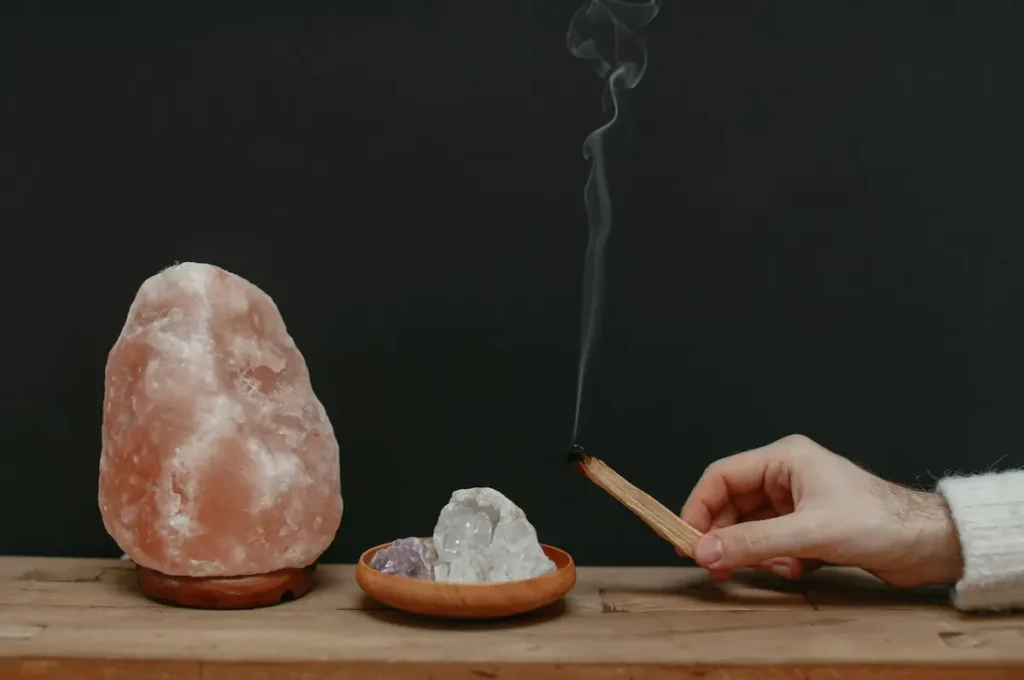
Certain crystals, particularly selenite and celestite, are commonly used alongside palo santo for cleansing work. Where palo santo clears energy through smoke, these crystals are believed to hold a naturally high, purifying vibration. This makes them a popular pairing for those who want to combine scent-based and stone-based clearing in the same ritual. As such, some people hold a crystal in hand while the stick burns, while others place one nearby, allowing it to charge in the smoke as it passes.
Palo Santo and Incense
Both palo santo and incense rely on smoke and scent, but they work slightly differently. Incense typically burns continuously from one end to the other, offering a longer, steadier scent, while palo santo smoulders in shorter bursts. Some people also choose to alternate between the two depending on mood or occasion. This can include using incense for a longer, ambient session, and palo santo for a shorter, more intentional ritual.
Palo Santo and Sound
Sound tools, such as singing bowls, bells, or simple clapping, are sometimes used together with palo santo to clear energy through both scent and vibration at once. A common approach is to burn the stick first, then follow with a few minutes of sound. This using the tone to help settle and anchor the space once the smoke has cleared.
Palo Santo Safety: What to Know Before You Burn
Palo santo is generally safe to use at home. However, a few basic precautions can make a real difference, particularly since it involves an open flame and smoke indoors.
Firstly, ventilation matters most. Open a window or door before you begin, both to let fresh air in and to give the smoke somewhere to go, rather than settling in the room. This is especially important if you’re sensitive to smoke, have asthma, or are cleansing a smaller, enclosed space.
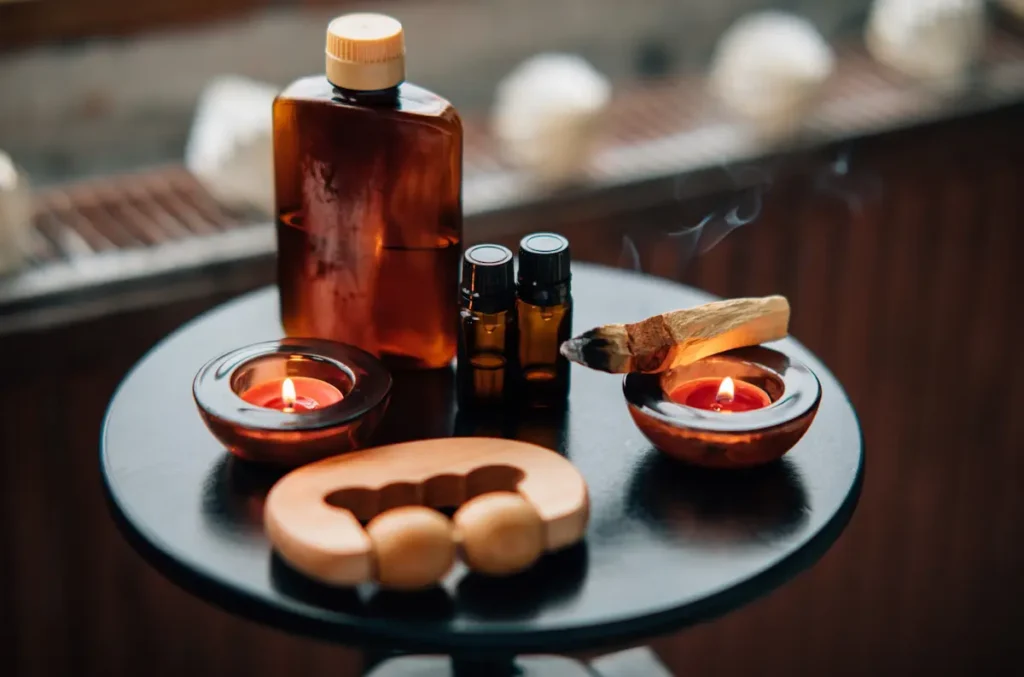
Moreover, always burn palo santo over a fireproof surface, such as an abalone shell, ceramic dish, or heatproof tray. Make sure to also keep it well away from curtains, paper, or anything flammable while it’s smoking. Never leave a lit stick unattended, even once the flame is out and it’s only smouldering, and keep it out of reach of children and pets throughout.
If you are pregnant, or have respiratory sensitivities, it’s worth checking with a doctor before regularly burning any smoke-based tool, palo santo included. As with any burning practice, moderation and common sense go a long way.
Is Palo Santo Sustainable? Sourcing It Ethically
Palo santo’s growing popularity has raised real concerns about over-harvesting, and it’s worth understanding before you buy.
The tree is native to dry tropical forests in Peru, Ecuador, and parts of Central America. Traditionally, it is also never cut down while alive. Genuine palo santo comes only from trees that have already fallen naturally, then rested on the forest floor for several years, allowing the wood’s aromatic oils to fully develop. This slow, natural process is part of what makes authentic palo santo so effective, but it also means supply is genuinely limited.
As demand has increased globally, so has the risk of unsustainable harvesting. This includes trees being cut down before they’re ready, or before they have fallen naturally at all. In some regions, this has even pushed local palo santo populations toward genuine scarcity. As a result, both Peru and Ecuador now have laws restricting the cutting of living trees.
To source palo santo ethically, look for suppliers who are explicit about sustainable, naturally-fallen sourcing, rather than vague claims of being eco-friendly. Reputable sellers are usually transparent about where their wood comes from and how it’s harvested. If a price feels unusually low for the amount offered, it is often worth a second look. Genuine, properly-aged palo santo is a slower, more limited product than mass-produced incense, and its price should generally reflect that.
Real vs. Fake Palo Santo: How to Spot Genuine Wood
As palo santo has grown in popularity, so has the number of low-quality or artificially scented substitutes on the market. To get the genuine product, it is worth knowing what to look for.
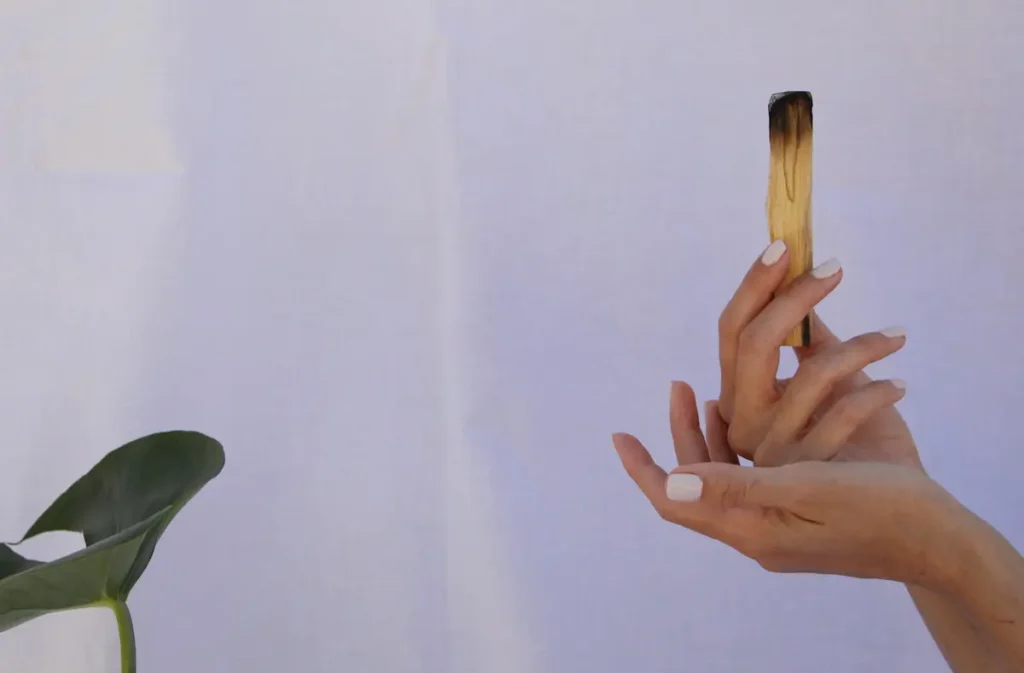
Genuine palo santo has visible resin running through the wood, often seen as darker, slightly oily lines along its surface. This resin is what gives the wood its scent and its ability to hold a smoulder, so wood without it tends to burn weakly and smell faint. Authentic sticks also carry a faint, warm fragrance even before they’re lit. Simply holding a piece close is often enough to notice it.
Fake or poor-quality palo santo, by contrast, is usually made from a different, unrelated wood, sometimes treated with artificial fragrance to mimic the scent. It typically smells like very little when unlit, burns quickly, and produces a thinner, less complex smoke once lit.
With that in mind, looking for suppliers who name their sourcing directly, is one of the clearest ways to confirm what you’re buying is both genuine and sustainably harvested. This includes a certification such as Peru’s SERFOR, its national forestry authority. A price that feels unusually low for the amount offered is often worth a second look too. Properly aged, authentic palo santo takes years to prepare, and its price should generally reflect that.
Common Mistakes to Avoid
A few small missteps come up often, especially for those learning how to use palo santo for the first time.
Holding the stick upright instead of at an angle. This makes it harder for the wood to catch evenly, and often leads to a weaker, shorter burn.
Burning it for too long before blowing it out. Letting the flame burn for several minutes, rather than 30 to 60 seconds, tends to waste the stick faster without improving the result.
Assuming it should stay in constant flame, like a candle. Palo santo is meant to smoulder and smoke once the flame is out, not burn continuously. Relighting a few times per session is normal, not a failure.
Using water to put it out. This can damage the wood and make it harder to relight next time. Instead, gently press the smouldering tip into sand or soil, or simply let it extinguish naturally in its dish.
Buying unusually cheap sticks without checking the source. As covered above, properly sourced, naturally-aged palo santo takes years to prepare. A very low price is often a sign of poor quality or unsustainable harvesting.
FAQ: How to Use Palo Santo
What’s the difference between burning palo santo, sage, and incense?
Palo santo burns in short bursts and carries a sweet, woody scent used to invite in positive energy. Sage burns more continuously and is traditionally used to clear negative energy specifically. Incense burns steadily from end to end, offering a longer-lasting scent, without the same ritual significance tied to clearing or blessing a space.
When should you use palo santo?
Common times include after an argument, before or after meditation, when moving into a new space, or simply whenever a room starts to feel heavy or stagnant.
Can you use palo santo every day?
Yes, though many people find a few times a week is enough. Burning it too frequently in a small space can also make the scent less noticeable over time.
Does palo santo expire?
Not exactly, but it can dry out over long periods, which may affect how easily it lights. Storing it somewhere cool and dry helps preserve it.
Is palo santo safe for pets?
Smoke from any burning material can affect pets, particularly birds, more than humans. It’s best to keep them in a separate, well-ventilated room while burning.

Final Thoughts
Learning how to use palo santo is less about getting every step perfectly right, and more about building a simple ritual you willl actually return to. Whether you are clearing a space after a hard day, setting an intention before something new, or simply enjoying the scent itself, the process stays the same. Light your palo santo with care, let it smoke, and give it a purpose while it burns. Used thoughtfully, and sourced sustainably, palo santo can become a small, steady part of a much wider spiritual practice.