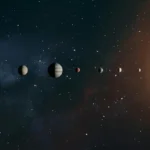
Maldek starseeds (also known as Maldekians) are a fascinating lineage within the starseed movement, believed to originate from a planet that once existed where the asteroid belt lies today. Their story combines elements of cosmic history, advanced civilisations, and planetary transformation, offering insight into both their traits and soul mission. By examining their origins, characteristics, and role in the universe, we can better understand how this unique lineage fits into the broader tapestry of starseeds and the ongoing dialogue between modern astronomy and metaphysical perspectives.
Let’s check out our cosmic neighbours.

Galactic Origins of Maldek Starseeds
Maldek starseeds are described within the starseed movement as originating from the asteroid belt. Specifically, they are thought to come from a mythical precursor planet that once existed in this region. However, modern astronomy does not support this interpretation. Scientists instead view the asteroid belt as the product of disrupted planetary formation, not as the remains of a former planet.
Nonetheless, in modern astronomy, the asteroid belt is understood as a disc of material orbiting the Sun, located between the orbits of Mars and Jupiter. Rather than being a single body, it consists of millions of rocky and metallic objects ranging in size from microscopic dust to dwarf-planet-scale bodies such as Ceres, Vesta, Pallas, and Hygiea. The belt formed approximately 4.6 billion years ago during the early stages of solar system formation, emerging from the same protoplanetary disk of gas and dust that gave rise to the planets.
Unlike Earth or Mars, astronomers understand that material in this region never formed into a full planet. Jupiter’s strong gravitational forces increased collisions among the material and prevented it from coming together. As a result, scientists view the asteroid belt not as the remnants of a destroyed world, but as primordial building material that never fully assembled into a planetary body. The asteroids also preserve some of the earliest physical evidence of the solar system, revealing insights into planetary formation, development, and the Sun’s original chemical composition.

Discover Your Starseed Personality✨
Take our free quiz to discover your unique cosmic personality and gain clarity on your strengths, relationships, and soul mission. Unlock the starseed lineage that aligns with who you truly are.
Phaeton and the Lost Planet Theory
The idea of a lost planet in the region now occupied by the asteroid belt has a long history in both mythology and early astronomical speculation. In classical mythology, Phaeton was the son of the Sun god Helios, who famously lost control of the sun chariot, causing destruction on Earth. Early astronomers later drew inspiration from this story when hypothesising about a missing planet, connecting the concept of celestial catastrophe with the region between Mars and Jupiter.
Consequently, by the 18th and 19th centuries, astronomers observing the asteroid belt proposed that a fifth planet, sometimes called Phaeton, might have existed in this zone. According to these early theories, the planet had either been destroyed or broken apart, leaving behind the asteroids observed today. While modern astronomy does not support the existence of a former planet, the Phaeton hypothesis has persisted in both popular imagination and alternative cosmologies, providing a framework for narratives such as the Maldek origin story.
Interested in the full picture of all known starseed lineages? Check out our complete guide to starseed origins.

Celestial History of Maldekian Starseeds
Maldek starseeds originate from Maldek, a planet that once occupied the region now known as the asteroid belt. The planet developed alongside early Earth, Mars, and Venus as a fully formed world. Maldekian society thrived as a technologically advanced and scientifically sophisticated civilisation, deeply engaged in planetary engineering, energy management, and large-scale infrastructure. Unlike many starseed origin stories that emphasise spiritual or consciousness-based evolution, Maldek focused on mastering physical systems, applying knowledge, and advancing technology.
Moreover, Maldek played an active role within the broader galactic community. Maldekians participated in interplanetary and interstellar networks, contributing knowledge and technology to developing systems. Their civilisation advanced intellectually but grew increasingly unbalanced, as rapid technological progress outpaced ethical, ecological, and social stability. Over time, internal conflict, environmental strain, and the misuse of powerful technologies destabilised the planet. These factors culminated in a catastrophic event that made Maldek uninhabitable or destroyed it entirely, scattering its population across the cosmos.
Following the loss of their planet, Maldekian souls dispersed widely. Many survivors incarnated on neighbouring worlds, including Mars and Earth, as starseeds, while others migrated to more distant star systems or dimensions. Over time, many Maldekian souls reincarnated repeatedly on Earth, gradually integrating into the human population. This process was not exile, but as a long-term adaptation that allowed their lineage to continue through new planetary environments.
For a broader look at starseed origins and their place in the galaxy, check out our full timeline of starseed history.

Core Characteristics of Maldek Starseeds
Maldekian starseeds are known for their intelligence, strategic thinking, and natural ability to understand complex systems. They often approach challenges with careful planning and a focus on long-term consequences, reflecting the lessons carried from their lost world. Moreover, responsibility and pragmatism are central to their nature. They gravitate toward roles that involve problem-solving, innovation, or guiding the development of systems. This could include social, technological, or environmental advancements.
While highly analytical and independent, Maldekian starseeds also follow a strong ethical sense and commit to maintaining balance. Their desire to prevent harm, correct inefficiency, and ensure stability drives their actions in the communities and systems they engage with. As a result, many take on leadership, mentorship, or advisory roles. This is where their practical insight and vision for sustainable solutions often have the greatest impact. Finally, Maldekian starseeds demonstrate intellectual rigour and a purposeful drive to create order, responsibility, and long-term well-being in every context.

Key Signs You Might Be a Maldekian Starseed
Maldekian starseeds often feel a strong affinity for systems, technology, and structured problem-solving. They naturally seek to understand how things work and to improve them. As a result, they may be naturally analytical, strategic, and able to see patterns or inefficiencies that others overlook. A strong sense of responsibility toward the planet, society, or large-scale projects is common, along with an instinct to prevent harm or correct imbalance. Furthermore, Maldekian starseeds often take on leadership, mentorship, or other roles where they can implement practical solutions. They often feeling a deep need to contribute to long-term stability and sustainability. In addition, they may also experience an inner tension or restlessness when they encounter shortsightedness, inefficiency, or poorly managed systems. This reflects the lessons of their lost world and a desire to guide humanity toward more sustainable outcomes.
For a closer look at Earth’s planetary neighbours and their starseeds, see our guide to the Martians.

FAQ: What are Maldek Starseeds?
Q1. What is the difference between Maldek starseeds and Maldekian starseeds?
The difference is primarily in terminology. Some sources refer to starseeds from Maldek as “Maldek starseeds,” while others use “Maldekian starseeds.” Both terms refer to the same beings, but grammatically, “Maldekian starseeds” is more accurate.
Q2. Is Maldek the same as Theia, the planet theorised to have collided with Earth to form the Moon?
No, both modern astronomy and the starseed movement consider them separate. Both believe Theia collided with Earth around 4.5 billion years ago, forming the Moon. Maldek is a fully formed planet that once occupied the region of today’s asteroid belt, but only in the starseed movement.
Q3. Maldekians sound similar to Arcturians. How are they different as starseeds?
They differ in their purpose for advancement. On one hand, Maldekians celebrate technological progression for the sake of it. On the other, Arcturians use technology as a means for enhancing spirituality and guidance.
Q4. Are many people Maldekian starseeds because we live near their origin on Earth?
Maldekian starseeds are relatively rare. While Earth lies near their original solar system, their presence here is thought to be purposeful, tied to guiding humanity and applying the lessons of their lost world.
Q5. Is it possible that Maldek existed for real?
We don’t have all the answers yet. Modern astronomy does not support the existence of a former planet in the asteroid belt. However, starseed traditions treat Maldek as a real world whose history informs the mission and traits of Maldekian starseeds. It could be a combination of both.

Cosmic Closure
Maldek starseeds are one of the more intriguing galactic lineages because their origin sits at the intersection of two different narratives. On one hand, modern astronomy sees the asteroid belt as material that never formed into a planet. On the other, starseed history describes Maldek as a fully formed world whose destruction shaped the belt and its descendants. This makes them distinct from other starseeds, whose origins usually have a clear physical location, such as Pleiadians from planets orbiting stars in the Pleiades cluster.
Interestingly, this divergence also leaves room for interpretation. Perhaps a planet once existed but left no trace or perhaps Maldek refers to the asteroids themselves. Maldek could also have been comet interacting with the belt, or even a planet that ascended to a higher dimension. Comparing starseed narratives with modern astronomy is therefore compelling, as it highlights where perspectives meet and diverge. Personally, I am happy to believe that a planet once existed. After all, I wasn’t alive when it happened, and it sounds like a pretty cool origin story!
If you enjoyed learning about Maldekian starseeds, explore our other articles on starseed origins across the galaxy.
- What are Indigo Starseeds? Understanding the Origins
- Starseed Numerology: Decode Your Galactic Origins
- Signs You Are an Arcturian Starseed: 13 Clear Traits
Curious which starseed you are? The Starseed Personality Assessment gives you 12 insightful questions to explore your natural traits and dominant lineage — completely free.