
A small weight on a chain may seem an unlikely source of guidance, yet dowsing in its many forms has been practised for centuries. Holding a pendulum still and watching it begin to swing or circle can feel surprisingly personal, as though an answer is rising from somewhere just beneath the surface. Many people turn to pendulum dowsing to connect with their intuition, choose crystals or explore questions that logic alone cannot settle. This guide covers how it works, what it is used for, and how to choose between crystal, brass and wooden pendulums. It also walks through calibrating your first pendulum and, most importantly, how to ask the kind of questions that lead to clearer answers.
Let’s explore how to find your own answers, one swing at a time.

What Is Pendulum Dowsing?
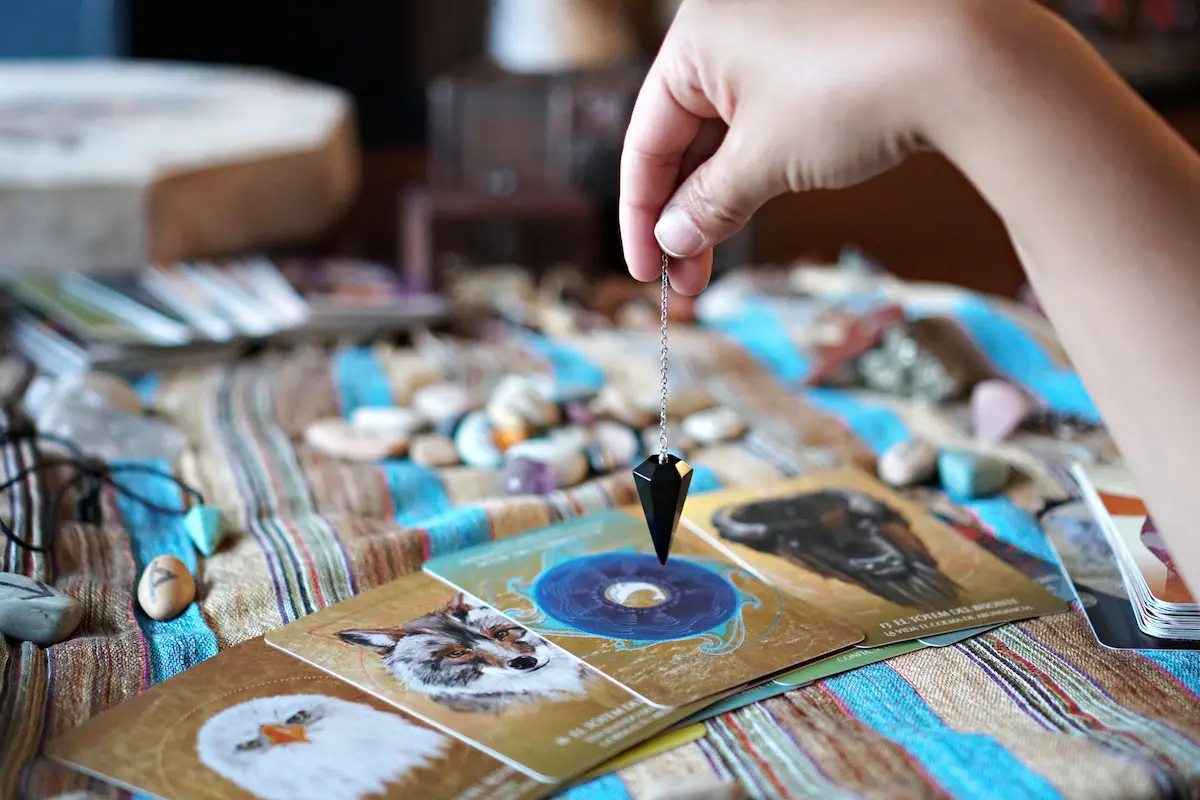
Pendulum dowsing is the practice of holding a small weighted object on a chain or cord and reading its movements as answers to questions.
A dowsing pendulum is usually made from crystal, metal or wood and balanced to swing freely from the fingertips. Many practitioners see it as a bridge to intuition, the higher self or spiritual guidance, which is why it ranks among the most enduring spiritual tools for awakening. Before asking anything meaningful, the dowser agrees on what each movement means, such as a forward swing for yes or a side-to-side swing for no. Pendulums belong to the wider family of dowsing, which also includes rods. Dowsing rods are traditionally L-shaped or forked and used outdoors to search for water or buried objects. Pendulums are smaller and more portable, and they are better suited to detailed questions asked at a table.

Which Starseed Are You? ✨
Curious where your soul’s story began? Take the free Starseed Personality Quiz and discover your dominant starseed lineage in just a few minutes.
A Brief History of Pendulum Dowsing
Dowsing has a longer recorded history than many people expect. In 1556, the German scholar Georgius Agricola described miners searching for metal ore with forked twigs in De re metallica, a landmark work on mining. Water dowsing appears in records soon after, and the practice spread across Europe despite periods of church disapproval. Pendulums gained popularity in the 19th century, and in 1854 the French chemist Michel Eugène Chevreul published a study of the so-called “explorer” pendulum. In the early 1900s, the French priest Alexis Bouly coined the term radiesthesia to describe this kind of sensitivity, and the British Society of Dowsers followed in 1933. Some trace pendulum use back to ancient Egypt and China, although reliable records are scarce. Today, pendulum dowsing sits comfortably alongside crystals, oracle cards and meditation in modern spiritual practice.
How Does Pendulum Dowsing Work?
There are two main ways of understanding what happens when a pendulum swings. Each speaks to a different kind of seeker, and many dowsers find room for both.
The Spiritual View
Many practitioners believe the pendulum responds to a source of knowing beyond the conscious mind. Depending on personal belief, this may be described as intuition, the higher self, spirit guides or the energy field said to surround every person and object. The pendulum is thought to act like an antenna, translating subtle impressions into visible movement. In this view, the clarity of an answer depends on the dowser’s openness, focus and emotional neutrality. Some also believe certain materials, such as crystal, help strengthen the connection.
The Ideomotor View
The other explanation centres on the body. In 1852, the physiologist William Benjamin Carpenter described the ideomotor effect, in which a thought or expectation produces tiny muscle movements without conscious intent. Chevreul reached a similar conclusion through his own pendulum experiments, finding that the swings came from small, unconscious motions of the hand. In this view, the pendulum mirrors what a person already knows, expects or hopes on some level.
Finally, it is important to note that, whatever the belief, a pendulum will not begin swinging on its own. Its movement always passes through the hand, whether guided by spirit, intuition or the subconscious. For many dowsers, this does not lessen the practice. Both views agree that the pendulum reflects something already within the person holding it.

What Is Pendulum Dowsing Used For?
Dowsing began as a way to find water and metal, but modern pendulum work is far more personal. Most dowsers use it for everyday guidance and self-reflection, keeping their questions simple and their expectations open.
Some of the most common uses include:
- Yes-or-no guidance: The pendulum’s best-known use is answering simple questions, from choosing between two options to checking how you feel about a decision.
- Choosing crystals: Holding a pendulum over several stones is said to reveal which one resonates most, a method often used when choosing crystals for starseeds.
- Finding lost items: Some dowsers move a pendulum slowly over a map or floor plan, watching for a change in its swing to narrow down where something may be.
- Sensing the energy of a space: A pendulum is sometimes used to check whether a room feels clear or heavy, often before and after a cleansing ritual.
- Checking the chakras: Suspended over each energy centre, a pendulum is believed to show how freely energy is flowing, making it a gentle companion to chakra balancing.
A pendulum is best seen as a tool for reflection rather than a replacement for professional advice. Questions about health, money or legal matters are better taken to a qualified expert.

Choosing a Pendulum: Crystal, Brass or Wood
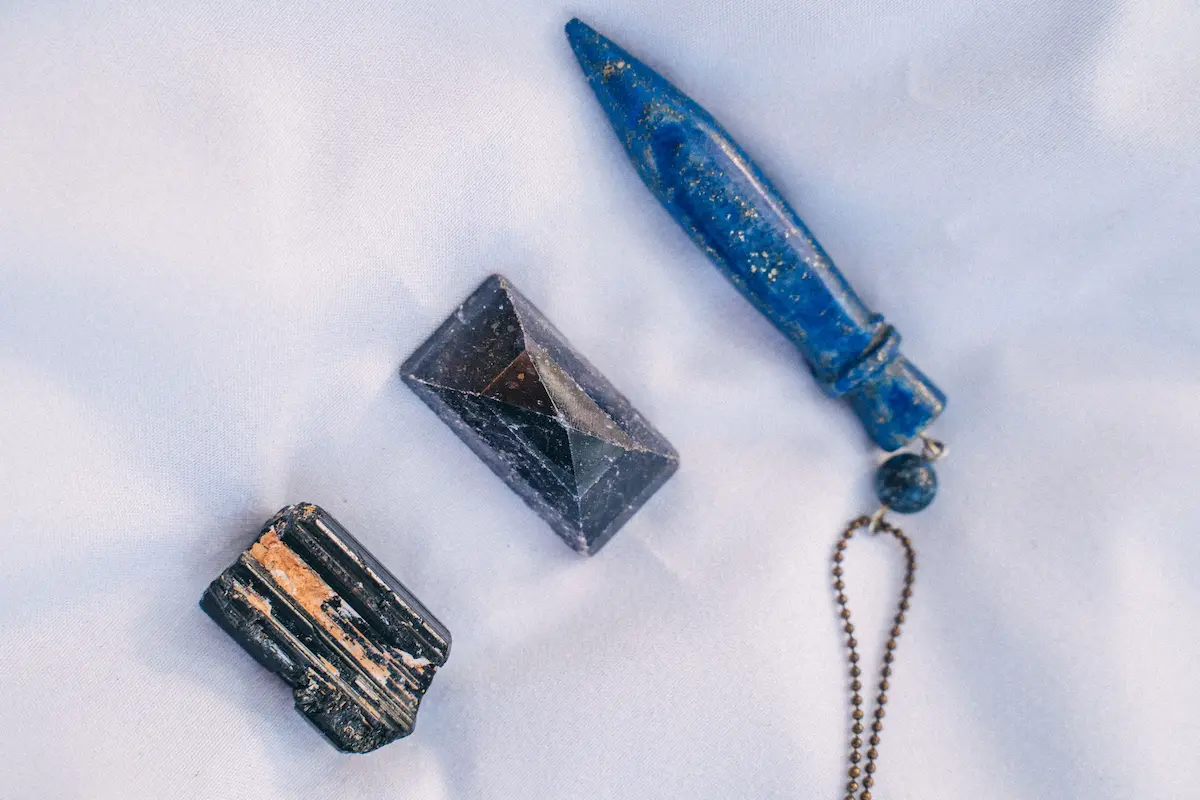
Most dowsers agree that the right pendulum is the one that feels right in your hand. Balance matters more than price. A pendulum with a moderate weight and a smooth, symmetrical shape tends to swing more clearly than one that is very light or uneven. Each material is also said to carry its own character, which can guide your choice.
Crystal Pendulum Dowsing
Crystal pendulums are the most popular choice in spiritual practice, prized for their beauty and the energy each stone is believed to hold. Clear quartz is a common first pendulum, often described as an amplifier that suits almost any question. Amethyst is linked with intuition and calm, while rose quartz is a favourite for questions of the heart. Many dowsers choose a stone that matches their intention, or simply the one they cannot stop looking at. Crystal can chip if dropped, so a soft pouch makes a wise companion.
Brass Pendulum Dowsing
Brass pendulums are a favourite among traditional dowsers. The metal is considered energetically neutral, meaning it is not thought to hold onto past energy or influence the answer. Brass is durable, evenly weighted and often shaped to a fine point, which makes it popular for map dowsing and pendulum charts. Some brass pendulums even include a small hollow chamber for holding a sample linked to the question. Brass may tarnish over time, although many dowsers enjoy the aged look.
Wooden Pendulum Dowsing
Wooden pendulums offer a warm, natural feel that many dowsers find grounding. They are light and sturdy, with little risk of breaking, which makes them practical for everyday use and travel. Their lighter weight can produce a gentler, slower swing that some beginners find easier to read. Wood is also a thoughtful choice for anyone who wants a simpler tool, or who feels more connected to the earth than to crystals or metal.

How to Use a Pendulum for Dowsing
What You’ll Need
Pendulum dowsing needs very little to begin. Choose a pendulum that feels balanced in your hand, and find a calm, uncluttered spot where you will not be interrupted, such as a starseed sanctuary or a favourite corner of your home. A table is helpful, since resting your elbow keeps the swing steady. Keep a notebook nearby to record your questions and answers, which helps you notice patterns over time. A pendulum chart and a cleansing tool, such as sage or a selenite plate, are optional extras.
Your First Pendulum Session
1. Cleanse and set your intention: Clear your pendulum and take a few slow breaths. Some dowsers say a short intention aloud, such as asking for clear and truthful answers.
2. Hold it correctly: Pinch the top of the chain lightly between your thumb and forefinger, leaving a few inches of chain free. Rest your elbow on the table and let the pendulum hang completely still.
3. Find your “yes”: Ask the pendulum to show you yes, then wait. It may swing forward and back, side to side or in a circle. Whatever it does becomes your yes signal.
4. Find your “no” and “unclear”: Repeat the process for no, then for an unclear or “not now” response. These three signals form your pendulum’s vocabulary.
5. Test with known answers: Ask simple questions you already know the answer to, such as “Is my name ___?” This confirms your signals before you move on.
6. Ask and record: Ask one clear question at a time, wait for the swing to settle, and note the response. Return the pendulum to stillness between questions.
How to Ask Your Pendulum the Right Questions
The quality of a pendulum’s answer depends largely on the question. A vague or emotionally loaded question tends to bring a vague or wavering swing, while a clear one gives the pendulum something simple to respond to.
A few guidelines can make a noticeable difference:
- Ask one thing at a time: “Should I take the job and move cities?” holds two questions, so split it into two.
- Keep it yes-or-no: Instead of “What should I do this weekend?”, try “Is resting at home the best choice for me this weekend?”
- Be specific about time: “Will I feel ready to start this project by the end of the month?” is clearer than “Will I be ready?”
- Stay neutral: If you are hoping for a particular answer, that expectation may sway the swing. Phrase the question evenly and take a breath before asking.
- Ask about alignment, not prediction: Pendulums are often seen as better suited to questions like “Does this feel right for me?” than to forecasting the future.
Using a Pendulum Chart
When a question has more than two possible answers, a pendulum chart can help. These charts are usually fan or semi-circle shapes divided into sections, each labelled with an option such as numbers, letters, colours, chakras or days of the week. Hold the pendulum over the centre point, ask your question and watch which section it swings towards. Many dowsers draw their own charts, which makes them easy to tailor to any question. Like every pendulum answer, a chart reading is best treated as a prompt for reflection rather than proof.
Pendulum Dowsing for Starseeds
Starseeds are often described as highly intuitive, sensitive to energy and drawn to tools that help them make sense of their inner world. For many, the pendulum becomes a natural companion on the path of awakening, offering a simple way to check in with feelings that are hard to put into words.
A few starseed-focused ways to work with it include:
- Exploring lineage resonance: Ask about each star family in turn, such as “Do I resonate with Pleiadian energy?”, or draw a chart of several lineages and see where the pendulum swings.
- Choosing lineage crystals: Hold the pendulum over stones linked to your star family to see which one feels most aligned.
- Recognising personal symbols: Dowse over a page of sacred geometry or starseed symbols to discover the shapes that hold meaning for you.
- Reflecting on downloads: Some starseeds use the pendulum to explore vivid dreams, synchronicities or sudden insights, asking whether a message feels true for them.
A pendulum response is best treated as one clue among many. Lineage resonance tends to reveal itself over time, through personality, memories, physical signs and the places that feel most like home.

How Many Starseeds Exist? ✨
A 166-page reference to 40+ starseed types and lineages, with detailed profiles on origins, traits, appearance and energy.
Can You Trust Your Pendulum?
How Accurate Is a Pendulum?
Accuracy is the question most beginners ask, and the answer depends on how you see the practice. Controlled scientific tests of dowsing, most of them using rods to search for water, have not found results more reliable than chance. Many dowsers, however, never treat the pendulum as a source of facts. They value it as a way to slow down, tune in and notice what they already sense. In practice, answers tend to feel clearer when the dowser is calm, neutral and asking about something with little emotional charge. Writing answers down and reviewing them later is one of the best ways to see how well the pendulum works for you.
Is Pendulum Dowsing Safe?
Pendulum dowsing is a gentle practice and generally considered safe. The main risk lies in leaning on it too heavily. A few simple habits keep it a healthy part of your spiritual life.
- Keep big decisions grounded: Use the pendulum for reflection, not for choices about health, money, legal matters or anyone’s safety.
- Notice anxious checking: If you find yourself asking the same question again and again, set the pendulum down and return another day.
- Avoid fear-based questions: Questions rooted in worry tend to bring worried answers. Come back when you feel settled.
- Respect other people’s privacy: Many dowsers believe it is best not to ask about someone else’s choices or future without their consent.

Keeping Your Pendulum Clear and Cared For
How to Cleanse Your Pendulum
Many dowsers believe a pendulum gathers energy from the people, places and questions it meets. Cleansing it is said to keep its answers clear, especially when it is new, after someone else has handled it or after a heavy or emotional session.
A few gentle methods to try:
- Smoke: Pass the pendulum through the smoke of burning sage or palo santo while holding a clear intention.
- Selenite: Rest it on a selenite plate or beside a selenite wand for a few hours or overnight.
- Moonlight: Leave it on a windowsill beneath the full moon to recharge.
- Sound: Ring a bell or singing bowl near the pendulum to clear stagnant energy.
- Breath and intention: Hold it in your palm, breathe out slowly over it and picture any heaviness dissolving.
How to Care for Your Pendulum
Take care with water, since some crystals, including selenite, can be damaged when wet. You can learn which stones need extra care in this guide on how to cleanse crystals. Brass may tarnish faster when damp and wood can swell, so a dry method is usually safest for every material. Store your pendulum in a soft pouch or box when it is not in use, away from hard surfaces that could chip a crystal point. Where possible, keep it as a personal tool rather than lending it out. Many dowsers find their pendulum responds more clearly the more often they work with it, and the bond between them tends to deepen with every question.

FAQ: Pendulum Dowsing
What does the word “dowsing” mean?
Dowsing means searching for something hidden, such as water, metal or an answer, by watching the movement of a rod or pendulum. The word’s origin is unknown. It began as a dialect term in southern England, first recorded in 1691, when John Locke wrote of a “deusing-rod.”
Do pendulums move on their own?
No. A pendulum’s movement always passes through the hand holding it. Many dowsers believe intuition, the higher self or spirit guides the swing, while others credit tiny unconscious muscle movements. Either way, the swing reflects something within the person dowsing.
Is pendulum dowsing real?
Pendulum dowsing is a real and widely practised tradition, although its results have not held up in controlled scientific tests. Many people still find it a meaningful way to slow down, reflect and reconnect with their intuition.
How can I learn pendulum dowsing?
Start by calibrating your yes, no and unclear signals, then practise daily with simple, low-stakes questions. Keeping a journal of your questions and answers helps you notice patterns and build confidence before moving on to charts.
What is the difference between a pendulum and dowsing rods?
Dowsing rods are usually a pair of L-shaped rods or a forked stick. They are held while walking and traditionally used outdoors to find water. A pendulum is a single weight on a chain, used while sitting still and better suited to detailed questions.

Final Thoughts
A pendulum asks very little of you. A steady hand, a calm moment and an honest question are enough to begin. Yet the practice offers something many people rarely find in a busy day: a pause long enough to hear what they already sense. Whether you see the swing as a message from spirit or a reflection of your own inner knowing, the pendulum’s greatest gift lies in the questions it teaches you to ask. Clear questions bring clear answers, and over time they bring a clearer sense of self. Start small, keep a journal and let your trust grow with each session. The pendulum may sway in your hand, but the wisdom it reveals has been yours all along.